(Disclaimer:
While I am trying to make each of these stories accurate, I must note that
these memories are over fifty years old. I am reporting, for the most part,
what I remember of these events. So far, they have been short, and given the
topics, true. Now, I take on a somewhat longer piece. It is a night mission and
I do have some very clear memories of what happened. But there are some facets
of this tale that I simply do not remember. However, only a few years after I
returned from Vietnam, I wrote some stories for a magazine named Combat
Illustrated. The story of the night mission is in it and there are things in
it that I do not remember. Having read it over now, my memory is refreshed. I
didn’t remember a briefing in the officers’ club, but given the article, I do,
sort of remember it. Yes, we did have the philosophical discussion after the
mission. The other thing is I believe that this is a mixture of two different
night missions. I can’t be sure of that, but it seems that some of the details
happened on another night with a different company. Having said all this, the essential
elements of the story are true… and some of the names have been changed because
it seemed like the thing to do at the time.)
We
were called to an evening meeting in the officer’s club, something that had not
happened before. True, we held meetings there, often to discuss the day’s
missions and what we could do to improve on our flight operations. This was different.
We were being briefed on the mission that would be held later, after midnight,
and it was expected that there would be contact.
We
were told that intelligence had learned that the VC would be moving into a
village at sunset to recruit men and steal rice, though they called it a collection
of taxes. We would land just after 0100 hours (1 a.m.) in the attempt to catch
them in the act. Another company would insert the blocking force about five
minutes after we landed and still another company would insert a second such
force. It was hoped that the VC would try to escape and run into one of the
blocking forces and if they chose to fight, the combat could get very rough for
those in the village.
One
of the first things I noticed as the meeting broke up was that the aircraft
commanders were drawing M-16s from supply. Normally, this would have outraged
the supply officer, but tonight he said nothing about it. When I went out to
pre-flight the aircraft, I saw that both the crew chief and the door gunner had
M-16s and that there were piles of ammunition under their seats. The crew chief
even had an M-79 grenade launcher. I don’t know where he got that.
The
AC showed up with several boxes of .38 ammo for our pistols and he had survival
kits and survival radios. He opened one of the kits and pulled out a large
piece of cloth that had an American flag with writing under it. He told me, “This
is a blood chit. In nine different languages and a variety of dialects it tells
the locals that the American government will pay a thousand bucks for your safe
return. Inside there is money and gold. I had to sign for these so I want them
back.”
Being
something of a smartass, and being that I was only 19, I asked, “What happens
if those people can’t read.”
“Then
your are well and truly screwed.”
I
picked up a box of the .38 ammo, opened it, and then shoved the single cartridges
into the loops of my Old West style gun belt. (You can see it in the first
picture on this blog).
As
I was finishing that, the AC spread the map out on the cargo compartment floor
and using his flashlight, with the red lens in place, showed me the LZs as they
had been planned, the location of the village, and the shortest distance to the
evac hospitals. He told me that for minor wounds, head for Dau Tieng and Cu Chi
for more serious injuries. He also made sure that I knew the radio frequency,
which was good for all the hospitals… 62.05. All this was something that hadn’t
been done before.
When
the AC finished, the crew chief asked if it was going to be that rough. The AC
said that he didn’t know. He just wanted to be sure that each of us knew what
to do in case he was hit. He said, “I’m just making sure that we’re all
prepared.”
We
waited for about twenty minutes and then climbed into the cockpit for engine
start. As soon as we were cranked and ready, the AC switched our intercom
system to “private” so that he could talk to me without the crew chief or the
door gunner listening. He said that it was going to be rougher than he had let
on. We were in trail which meant that there was a good possibility that we
would take some heavy fire.
He
then said that we were going to do things differently. After we reached the IP,
he wanted my hands on the controls. Not near them as we did under normal circumstances,
but actually on the controls. That would give me a better chance to take
control if necessary, especially as we neared the ground. He also said that as
we made the final run in to turn off the rotating target, his name for the
rotating beacon on the aircraft. Since we were trail, there was no one behind
us. This gave us a little better chance to avoid some enemy fire. I was also on
the “guard” frequency, the UHF channel that would broadcast to every other
aircraft in the area, in case we needed help quickly.
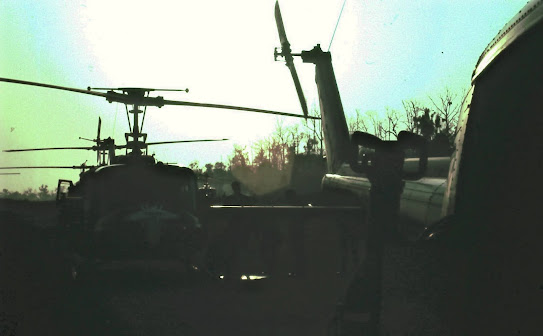 |
Hornet helicopters lined up for an upcoming mission. This was the night mission
described here. Photo copyright by Kevin Randle.
|
Rather
than line up on the assault strip for takeoff, we lined up on the active
runway. We formed a heavy right formation and when we got to the PZ, the troops
were lined up that way. It was better than the staggered trail that was strung
out behind lead.
Since
the soldiers couldn’t throw smoke at night, they were using small strobe
lights. That looked like the muzzle flashes. On landing we used the landing
lights but the searchlights were off. Once we touched down, those lights went
out. We didn’t want to set the grass and other vegetation on fire.
As
soon as the soldiers were on board, the crew chief said, “We’re loaded.”
I
glanced into the cargo compartment. They were all American soldiers. I knew that
without looking. Americans always went in if there was a possibility of
contact. If the contact was light, then they would be reinforced with ARVN. If
it was really hot, the reinforcements would be American.
The
AC told the crew chief to tell the soldiers to unass the aircraft as quickly as
possible. He replied, quietly, “They know.”
We
sat in the PZ, the minutes building slowly. C and C was coordinating with the
flare ship and the other companies. Because the target was a village, there
would be no arty prep. Once we were airborne, we would head directly to the LZ,
hoping that the VC would have little to no warning.
Lead
finally announced, “On the go.”
As
we broke ground, the AC said, “This one is for real, so let’s be alert.”


